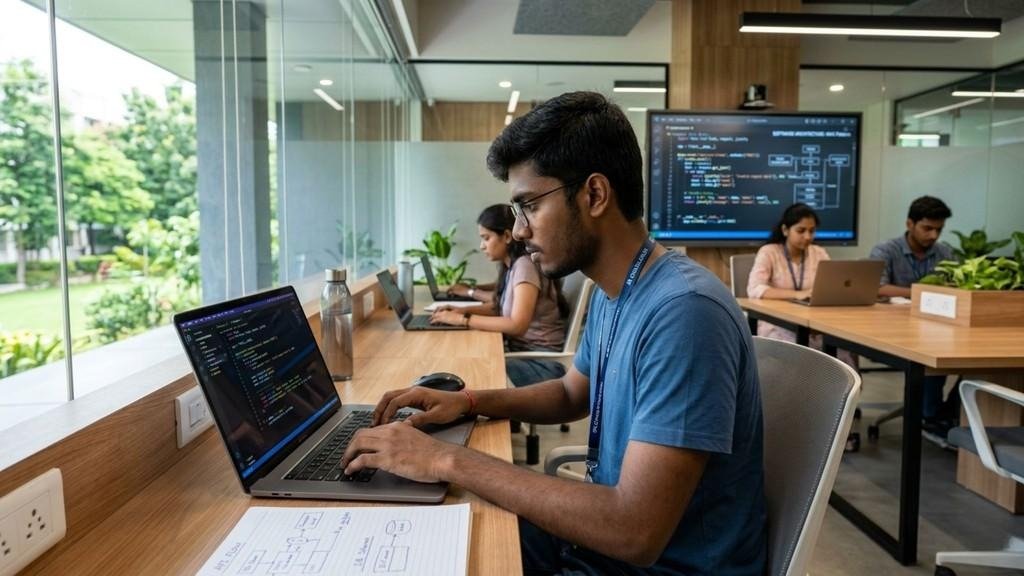
How to Get Your First IT Job in 2026
# How to Get Your First IT Job in 2026: A Complete Roadmap for Freshers
Are you a graduate looking for your first IT job but confused about where to start?
You are not alone. Many fresh graduates have degrees but struggle to understand which technical skills to learn, how to build projects, prepare resumes and face technical interviews.
The good news is that you don't need to master every programming language or technology to start your IT career. You need the right direction, consistent practice and a clear learning roadmap.
In this guide, we will explore how freshers can prepare for their first IT job in 2026.
## 1. Choose the Right IT Career Path
Before learning any technology, identify which IT career matches your interests and strengths.
Some popular IT career options include:
- Software Developer: Builds applications and software using programming languages.
- Full Stack Developer: Works on both frontend and backend development.
- Data Analyst: Analyses data and creates reports to support business decisions.
- Cloud Engineer: Works with cloud platforms and infrastructure.
- Cybersecurity Analyst: Helps protect systems, networks and sensitive information.
- AI & ML Engineer: Develops intelligent applications using artificial intelligence and machine learning.
- Software Tester: Tests applications to identify errors and improve quality.
Choose one career path instead of trying to learn everything simultaneously.
## 2. Learn the Required Technical Skills
Once you select your career path, start learning the technologies required for that role.
For example, if you want to become a Python Full Stack Developer, focus on:
Frontend Development
- HTML
- CSS
- JavaScript
- React fundamentals
Backend Development
- Python
- Django
- REST APIs
Database
- MySQL
- SQL queries
- Database relationships
Development Tools
- Git and GitHub
- VS Code
- Postman
Remember: Understanding concepts and applying them practically is more important than collecting certificates.
## 3. Build Practical Projects
Projects demonstrate your ability to apply technical knowledge.
Freshers should try to complete at least two or three meaningful projects.
Some beginner-friendly project ideas include:
- Student Management System
- Library Management System
- Employee Management System
- E-commerce Website
- Job Portal
- Task Management Application
For every project, understand its purpose, features, technologies used and your contribution.
Upload your projects to GitHub and maintain a professional portfolio.
## 4. Prepare an ATS-Friendly Resume
Your resume is often the first impression you create with a recruiter.
Make sure it includes:
- Professional summary
- Technical skills
- Educational qualifications
- Academic and personal projects
- Internship experience
- Certifications
- GitHub and LinkedIn profiles
Keep your resume simple, clear and relevant to the job description.
Avoid adding skills or projects that you cannot explain during an interview.
## 5. Prepare for Technical Interviews
Technical knowledge alone is not enough. You must also be able to explain your understanding clearly.
Important preparation areas include:
- Programming fundamentals
- Object-Oriented Programming
- Data Structures and Algorithms
- SQL and DBMS
- Operating Systems
- Computer Networks
- Project-based questions
- HR interview questions
Practice explaining your projects in simple language. Prepare for questions about your role, challenges, technologies and solutions.
## 6. Apply for IT Jobs Consistently
Don't wait until you feel 100% ready.
Start applying once you have basic technical knowledge and at least one working project.
Explore opportunities through:
- LinkedIn Jobs
- Naukri
- Indeed
- Company career pages
- Fresher hiring programmes
- Campus and off-campus drives
- Walk-in interviews
Check the job description carefully and apply for positions that match your skills and eligibility.
## 7. Follow a 90-Day IT Job Preparation Plan
Consistency is the key to building a successful IT career.
Days 1–30: Learn
- Select one target IT role.
- Learn the required programming language.
- Understand database fundamentals.
- Practice coding every day.
Days 31–60: Build
- Develop practical projects.
- Learn Git and GitHub.
- Create a professional portfolio.
- Update your resume.
Days 61–90: Prepare and Apply
- Practice technical interview questions.
- Prepare project explanations.
- Attend mock interviews.
- Apply for relevant fresher opportunities.
- Improve your skills based on interview feedback.
## Common Mistakes Freshers Should Avoid
1. Learning multiple technologies without mastering the basics.
2. Depending only on certificates without practical projects.
3. Copying projects without understanding the code.
4. Using the same resume for every job application.
5. Ignoring communication and interview skills.
6. Waiting too long before applying for opportunities.
## Final Thoughts
Getting your first IT job is a journey that requires patience, planning and continuous improvement.
You don't need to know everything before starting your career. You need to identify your target role, learn the right skills, build practical projects and prepare confidently for interviews.
Start with one step today. Your first IT opportunity could be closer than you think.
Need help choosing your IT career path?
TGLHUB helps students, freshers and job seekers understand career options, identify the right skills and prepare for IT opportunities.
Explore TGLHUB and take your next step towards a successful IT career.
Find Your Path. Build Your Skills. Get Career Ready.